
Skip to content
Maker profile · Le Brassus · Founded 1735

Blancpain The oldest continuously operating watchmaker.

Two-hundred-ninety years of mechanical watchmaking. The 1953 Fifty Fathoms beat the Submariner to market. No quartz, ever.

Blancpain Fifty FathomsPhoto by EMore98 (Wikimedia Commons), CC BY-SA 4.0 (source)

What is Blancpain?

Blancpain is a Swiss luxury watch manufacturer founded 1735 in Villeret — the oldest watchmaker in continuous operation. Production: fewer than 30 watches per day (approximately 9,000-10,000 per year). The Fifty Fathoms (1953) was one of the first modern dive watches, predating the Rolex Submariner. The corporate motto — "Blancpain has never made a quartz watch and never will" — has held for over 90 years. Part of the Swatch Group since 1992.

History

Jehan-Jacques Blancpain registered his watchmaking workshop in Villeret, in the Bernese Jura, in 1735. The document survives in the Blancpain archives and remains the earliest written evidence of the company. The Blancpain family produced watches for six generations until the line ended with Frédéric-Émile Blancpain's death in 1932. Without a male Blancpain heir, the company was reorganized but continued in operation through the 1930s and beyond.

The 20th century was difficult. The quartz crisis (1970s) hit Blancpain hard — like much of the Swiss industry, the company became inactive for portions of the 1970s. In 1983, Jean-Claude Biver and Jacques Piguet bought the dormant Blancpain name for $22,000 specifically to relaunch it as a pure-mechanical watchmaker — a position no major Swiss brand was occupying as the industry capitulated to quartz. The relaunch worked. Blancpain became one of the highest-margin watchmakers in the post-quartz era. In 1992, Nicolas Hayek acquired Blancpain for SwatchGroup.

The technical record:

  • 1735 — Jehan-Jacques Blancpain registers as a watchmaker
  • 1926 — First automatic wristwatch (the Harwood, produced under Blancpain license)
  • 1953 — Fifty Fathoms released, developed for the French Navy combat divers
  • 1956 — World's smallest round movement, Caliber R550
  • 1991 — 1735 Grande Complication released for the brand's 256th anniversary — six complications
  • 2007 — Le Brassus Carrousel One Minute Tourbillon (carrousel + tourbillon, world first)
  • 2009 — Air Command (chronograph reissue)

Signature collections

Fifty Fathoms

The dive collection. Fifty Fathoms 5015 ($15,400 in steel) — 45mm, 300m water resistance, in-house Caliber 1315 with three-day power reserve. Fifty Fathoms Bathyscaphe ($14,000) is the smaller (38-43mm) more wearable variant. Limited editions tied to ocean conservation (Fifty Fathoms Ocean Commitment) and historical reissues (Fifty Fathoms Tribute) extend the line. The 70th anniversary 2023 collection was particularly well-received.

Villeret

The dress collection — round case, double-stepped bezel, fluted lugs, classical Blancpain dial language. Villeret Ultra-Slim ($12,000-$16,000), Villeret Quantième Complet ($26,800), Villeret Quantième Perpétuel ($86,500), Villeret Tourbillon Carrousel ($350,000). The Villeret line is the brand's most traditional and the most fully resolved dress-watch language in the Swatch Group portfolio.

1735 Grande Complication

The technical-flagship reference. Six complications — minute repeater, perpetual calendar, tourbillon, split-seconds chronograph, moon phases. Released 1991 for the brand's 256th anniversary. Each piece takes over a year to produce. New examples reach $800,000+. The reference is the ultimate expression of Blancpain's post-relaunch ambition under Biver and Piguet.

Air Command

Chronograph collection inspired by mid-20th-century military pilot watches. Air Command Chronograph ($18,800), Air Command Concept (limited editions). Larger and more aggressive than the Villeret but quieter than the Fifty Fathoms.

L-Evolution

Modern angular case shape with technical movements — Tourbillon Carrousel, Chronograph Flyback. Less popular than the round-case collections but technically interesting. Production has scaled down in recent years.

Price tiers

  • Entry — Villeret Ultra-Slim ($12,000-$16,000), Fifty Fathoms Bathyscaphe ($14,000)
  • Mid — Fifty Fathoms 5015 ($15,400), Air Command ($18,800), Villeret Quantième Complet ($26,800)
  • Flagship — Villeret Quantième Perpétuel ($86,500), Le Brassus Tourbillon Carrousel ($350,000)
  • Grand complications — 1735 Grande Complication ($800,000+), Le Brassus Tourbillon Carrousel ($350K-$500K)
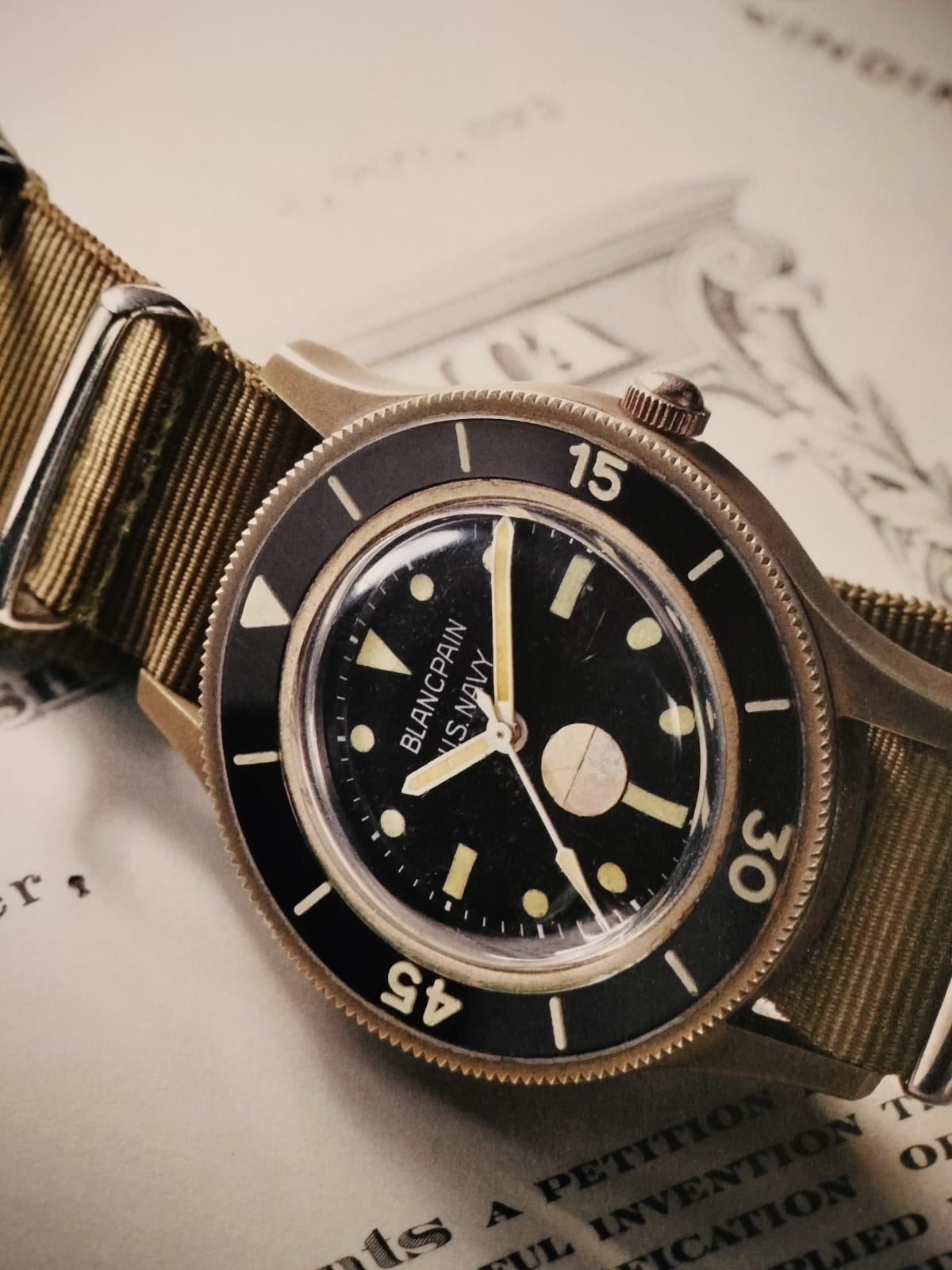
  • Collector — Vintage Fifty Fathoms (1953-1980), early Bathyscaphes, Tornek-Rayville (the U.S. Navy variant). $20K-$200K+

What's worth knowing

The Fifty Fathoms predates the Rolex Submariner. The Submariner debuted at Baselworld 1954; the Fifty Fathoms was already in service with the French Navy by 1953. Both watches credit independent invention of the dive watch concept, and both used similar fundamentals — rotating timing bezel, screw-down crown, water resistance to ~100 meters. Among watch historians, the Fifty Fathoms typically gets credit as the first modern dive watch; in the broader culture, the Submariner gets credit because Rolex marketed it more aggressively.

Blancpain's ocean-conservation positioning is unusually integrated. The brand sponsors the Blancpain Ocean Commitment program — funding marine biology research, ocean exploration documentaries, and conservation initiatives. Co-branded Fifty Fathoms references support the program. The positioning predates the broader luxury industry's sustainability turn.

Jean-Claude Biver — who relaunched Blancpain in 1983 — went on to lead Hublot in 2004 and turn Hublot into one of the most commercially successful Swiss watch brands of the 2000s. Biver's Blancpain work is generally considered the more horologically serious of his career. The Blancpain relaunch laid the groundwork for the entire post-quartz mechanical revival.

Read next

Frequently Asked

On Blancpain

Is Blancpain really the oldest watchmaker?

Yes. Jehan-Jacques Blancpain registered his watchmaking workshop in Villeret, Switzerland, in 1735. Production has continued under the Blancpain name continuously since — making it the oldest watchmaker in continuous operation. Vacheron Constantin (1755) is the oldest continuously operating watch <em>manufacturer</em> (incorporated company), but Blancpain predates Vacheron by 20 years as a registered watchmaking business.

What is the Fifty Fathoms?

The Fifty Fathoms is Blancpain's dive watch — released 1953, predating the Rolex Submariner by months. It was developed for the French Navy's combat diving unit (the Nageurs de Combat), which had asked Blancpain to design a watch capable of supporting tactical underwater operations. The original Fifty Fathoms (50 fathoms = 91.45 meters water resistance) introduced the rotating timing bezel, screw-down crown, and luminous dial markings that became standard across the dive watch category. The modern Fifty Fathoms (45mm, 300m, in-house Caliber 1315) starts at $15,400.

Has Blancpain ever made a quartz watch?

No. The corporate motto is unambiguous: "Blancpain has never made a quartz watch and never will." The brand has held to it. Even during the quartz crisis (1970s-80s) when nearly every major Swiss watchmaker reduced production or went bankrupt, Blancpain refused to switch to quartz movements. The company was actually inactive for parts of the 1970s rather than compromise — Jean-Claude Biver and Jacques Piguet relaunched the company in 1983 specifically to preserve mechanical watchmaking. The quartz prohibition has held for over 90 years.

Who owns Blancpain?

Blancpain has been part of the Swatch Group since 1992. Nicolas Hayek (Swatch Group founder) acquired the company shortly after the Group was formed. Blancpain operates with significant autonomy within the Group structure and is positioned as one of the Group's top-tier brands alongside Breguet and Omega.

How many Blancpain watches are made?

Blancpain produces fewer than 30 watches per day — approximately 9,000-10,000 per year. The output is by design — Blancpain emphasizes hand-finishing and the 50 Fathoms+ heritage rather than scale. Production is the smallest of the three Swatch Group prestige brands.

Which Blancpain is the best entry?

The Villeret Ultra-Slim ($12,000-$16,000) is the dress-watch entry — a 38mm round case with classical Blancpain dial language, fluted lugs, in-house movements. The Fifty Fathoms Bathyscaphe ($14,000-$16,000) is the sport-dive entry — a smaller, dressier variant of the Fifty Fathoms. The full Fifty Fathoms ($15,400) is the canonical Blancpain dive watch and the brand's most recognized signature.

What is Blancpain?

Blancpain is a Swiss luxury watch manufacturer founded 1735 in Villeret — the oldest watchmaker in continuous operation. Production: fewer than 30 pieces per day (approximately 9,000-10,000 per year). The Fifty Fathoms (1953) is one of the first modern dive watches, predating the Rolex Submariner. Corporate motto: "Blancpain has never made a quartz watch and never will." The brand has held to it for over 90 years. Part of the Swatch Group since 1992. Best known for the Fifty Fathoms, the 1735 Grande Complication, and the Villeret dress collection.

Is Blancpain really the oldest watchmaker?

Yes. Jehan-Jacques Blancpain registered his watchmaking workshop in Villeret, Switzerland, in 1735. Production has continued under the Blancpain name continuously since — making it the oldest watchmaker in continuous operation. Vacheron Constantin (1755) is the oldest continuously operating watch <em>manufacturer</em> (incorporated company), but Blancpain predates Vacheron by 20 years as a registered watchmaking business.

What is the Fifty Fathoms?

The Fifty Fathoms is Blancpain's dive watch — released 1953, predating the Rolex Submariner by months. It was developed for the French Navy's combat diving unit (the Nageurs de Combat), which had asked Blancpain to design a watch capable of supporting tactical underwater operations. The original Fifty Fathoms (50 fathoms = 91.45 meters water resistance) introduced the rotating timing bezel, screw-down crown, and luminous dial markings that became standard across the dive watch category. The modern Fifty Fathoms (45mm, 300m, in-house Caliber 1315) starts at $15,400.

Has Blancpain ever made a quartz watch?

No. The corporate motto is unambiguous: "Blancpain has never made a quartz watch and never will." The brand has held to it. Even during the quartz crisis (1970s-80s) when nearly every major Swiss watchmaker reduced production or went bankrupt, Blancpain refused to switch to quartz movements. The company was actually inactive for parts of the 1970s rather than compromise — Jean-Claude Biver and Jacques Piguet relaunched the company in 1983 specifically to preserve mechanical watchmaking. The quartz prohibition has held for over 90 years.

Who owns Blancpain?

Blancpain has been part of the Swatch Group since 1992. Nicolas Hayek (Swatch Group founder) acquired the company shortly after the Group was formed. Blancpain operates with significant autonomy within the Group structure and is positioned as one of the Group's top-tier brands alongside Breguet and Omega.

How many Blancpain watches are made?

Blancpain produces fewer than 30 watches per day — approximately 9,000-10,000 per year. The output is by design — Blancpain emphasizes hand-finishing and the 50 Fathoms+ heritage rather than scale. Production is the smallest of the three Swatch Group prestige brands.

Which Blancpain is the best entry?

The Villeret Ultra-Slim ($12,000-$16,000) is the dress-watch entry — a 38mm round case with classical Blancpain dial language, fluted lugs, in-house movements. The Fifty Fathoms Bathyscaphe ($14,000-$16,000) is the sport-dive entry — a smaller, dressier variant of the Fifty Fathoms. The full Fifty Fathoms ($15,400) is the canonical Blancpain dive watch and the brand's most recognized signature.

What is The Essential Watch Guide?

The Essential Watch Guide is an editorial publication covering luxury watchmaking — Swiss heritage houses, dive watches, vintage timepieces, and the makers worth knowing. Coverage includes Rolex, Patek Philippe, Audemars Piguet, Vacheron Constantin, Omega, Tudor, and dozens more. Editorial focus: history, signature collections, what to look for when buying, and how value holds.

Which Swiss watch brands are the most prestigious?

The "Holy Trinity" of Swiss watchmaking is Patek Philippe (founded 1839), Audemars Piguet (1875), and Vacheron Constantin (1755) — the three houses widely considered the apex of haute horlogerie. Rolex is the most recognized worldwide; Jaeger-LeCoultre supplies movements to many top brands; Blancpain is the oldest continuously operating watchmaker (founded 1735). Independent makers like F.P. Journe and Richard Mille operate at the same tier with smaller production runs.

What makes a watch "Swiss made"?

Swiss law requires that a watch labeled "Swiss made" must have its movement assembled in Switzerland, its movement cased in Switzerland, undergone final inspection by the manufacturer in Switzerland, and have at least 60% of its production cost incurred in Switzerland. The standard is enforced by the Federal Council and the Federation of the Swiss Watch Industry FH.