
What is Cartier?
Cartier is a French luxury jewelry house founded 1847 by Louis-François Cartier in Paris, with a major Swiss watchmaking program based in La Chaux-de-Fonds. Louis Cartier created the Santos (1904) — one of the first modern men's wristwatches — and the Tank (1917) — the most iconic rectangular dress watch ever made. Cartier produces in-house movements (Caliber 1904 family since 2010, plus high-complication calibers) and uses ETA-derived movements in mid-range references. Part of Richemont since 1993.
History
Louis-François Cartier opened a jewelry workshop in Paris in 1847. His son Alfred Cartier expanded the business; his grandson Louis Cartier (1875-1942) built the brand into a global luxury house and led the watchmaking program. Louis Cartier was a personal friend of Brazilian aviator Alberto Santos-Dumont, who complained at a 1904 Paris dinner that pocket watches were impractical for piloting. Louis designed a flat wristwatch with a leather strap — the Santos — for his friend. The watch became commercially available in 1911. It is widely considered the first purpose-designed men's wristwatch.
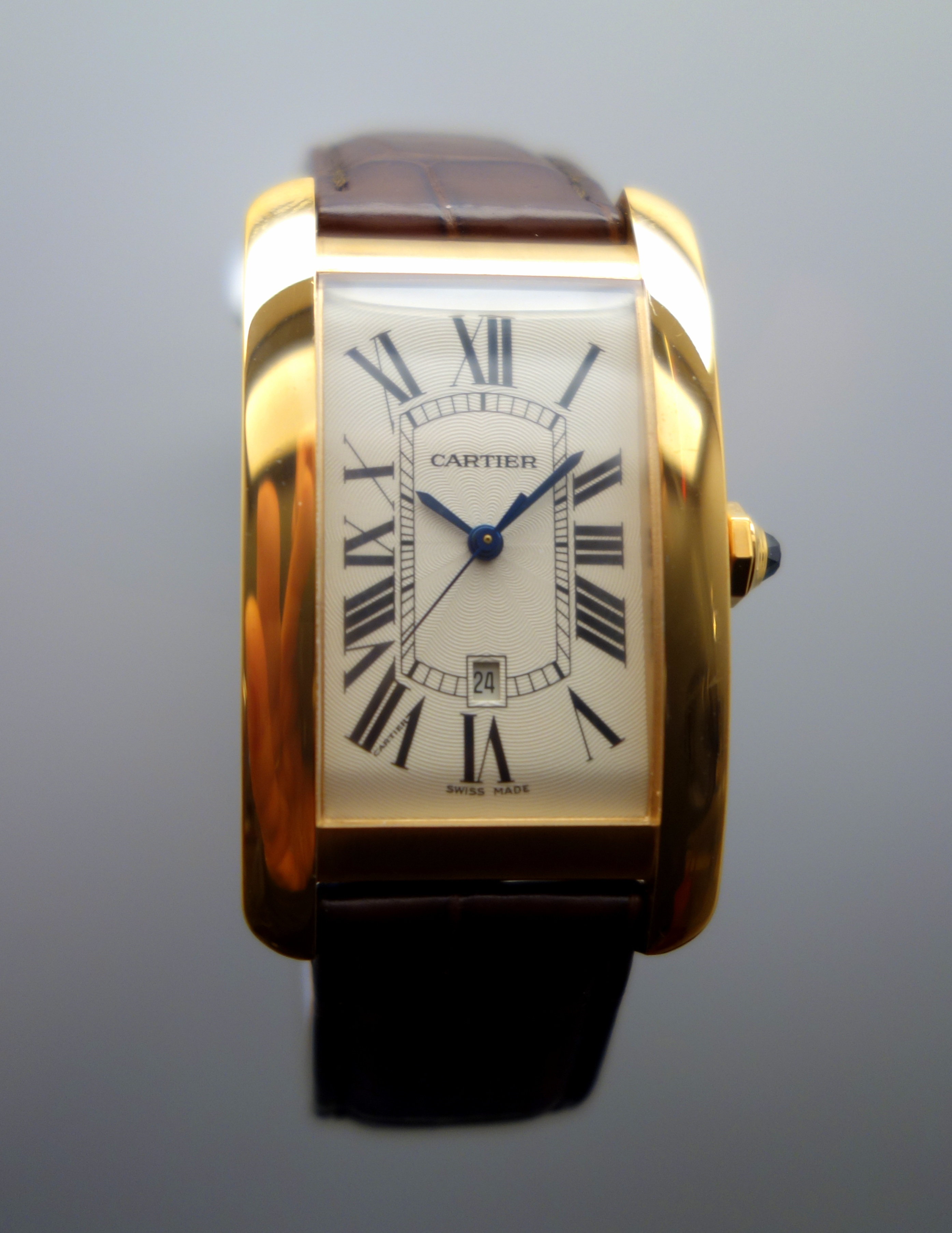
The Tank was designed in 1917, inspired by the rectangular silhouette of the Renault FT tank visible in WWI photographs. Louis Cartier presented the first Tank to General John Pershing in 1918. Commercial production began in 1919. The Tank's vertical brancards (the bars on either side of the dial), Roman numerals, blued steel hands, and rectangular case have defined the dress-watch category ever since.
The case shape was inspired by the Renault FT-17 light tank seen from above. The lugs were the treads.
Louis Cartier on the Tank, 1917
Across the 20th century Cartier produced an unusual variety of case shapes — Tortue (1912), Tonneau (1906), Pasha (1932 for the Pasha of Marrakesh, mass-released 1985), Crash (1967), Drive (2016). The brand maintains a distinct horological aesthetic — case shape variation that no other Swiss house attempts at scale.
Cartier launched its Fine Watchmaking program in 2008 with the Calibre de Cartier. The 2010 Caliber 1904 MC was Cartier's first fully in-house volume movement. The Privé Collection (since 2018) reissues iconic Cartier shapes with in-house movements at limited production scales.
Signature collections
Tank
The most iconic Cartier. Tank Must ($3,200-$4,400, quartz or low-cost mechanical), Tank Solo ($3,200-$5,150), Tank Française ($4,800-$6,800), Tank Louis Cartier ($14,200 in gold), Tank Cintrée Privé Collection ($55,000+), Tank Asymétrique Privé Collection ($60,000+). The Tank is available in dozens of variants — leather strap, steel bracelet, gold, mechanical, quartz, dress, sport.
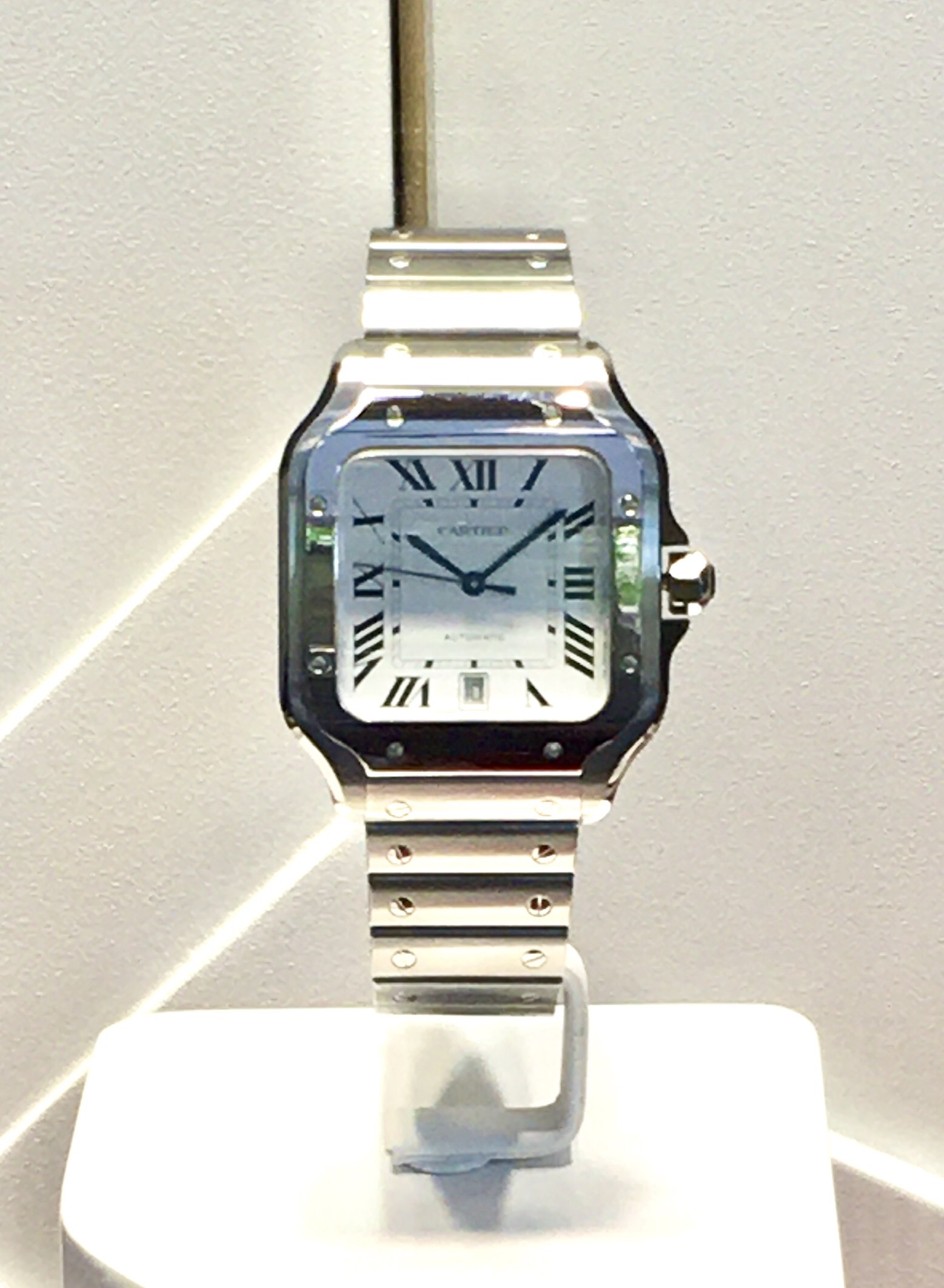
Santos
The first modern men's wristwatch. Santos Medium Steel ($7,400), Santos Large Steel ($8,700), Santos-Dumont ($6,750), Santos de Cartier Skeleton ($23,800), Santos Chronograph ($10,400). Released 1904, redesigned multiple times — the modern reference (2018 redesign) is the Santos at its most refined.
Pasha
The cushion-case sport collection. Pasha de Cartier ($6,400-$15,000), Pasha 41mm Chronograph ($14,400). Released 1932 as a custom commission for the Pasha of Marrakesh. Mass-released 1985. The most divisive Cartier — collectors either love the round-cushion proportions or find them awkward.
Ballon Bleu
The modern dress collection. Ballon Bleu ($5,800-$15,000), Ballon Bleu Skeleton ($28,000). Round case with characteristic blue cabochon crown set into the side. One of Cartier's most successful 21st-century releases.
Crash, Privé Collection, and Métiers d'Art
The collector and high-jewelry pieces. Original 1967 Crash ($400K+ at auction). Privé Collection Crash limited editions ($45K-$75K). Privé Collection Tank Cintrée, Tank Asymétrique, Tonneau. Métiers d'Art enameled and gem-set pieces ($50K-$500K+).
The Crash is the watch other watches apologize for not being. Discontinued. Reissued. Discontinued again. Worn by people who don’t need to explain.
Price tiers
- Entry — Tank Must ($3,200-$4,400), Tank Solo ($3,200-$5,150), Santos-Dumont ($6,750)
- Mid — Santos Medium Steel ($7,400), Tank Française ($4,800-$6,800), Ballon Bleu ($5,800-$8,500)
- Flagship — Santos Skeleton ($23,800), Tank Louis Cartier in gold ($14,200), Santos Chronograph ($10,400), Calibre de Cartier ($8,500-$28,000)
- Privé Collection — $45,000-$200,000 (Crash, Tonneau, Asymétrique, Cintrée)
- Métiers d'Art and high jewelry — $50K-$2M+. Enameled, gem-set, panther motif pieces.
- Vintage — Original 1967 Crash, JLC-movement vintage Tanks, Pasha de Cartier 1985-2000 references. $50K-$2M+
What's worth knowing
Cartier's position in the watch world is unusual. The brand is owned and run as a jewelry house — Cartier's revenue is dominated by jewelry, leather, and accessories — but the watchmaking program is one of the most influential in horology history. Among Richemont brands, Cartier is the largest by revenue but is rarely listed alongside the "serious" watchmakers like Vacheron, JLC, or Lange. Among watch collectors, Cartier is increasingly recognized as one of the most original design houses in the industry — particularly the case-shape variation no other major brand attempts.
The Tank's cultural reach is unmatched. Andy Warhol said of his Tank: "I don't wear a Tank to tell the time. In fact, I never wind it. I wear a Tank because it's the watch to wear." Princess Diana's Tank Française. Jackie Kennedy's Tank Louis. Yves Saint Laurent's Tank Cintrée. Steve McQueen's Tank. Truman Capote's Tank. The watch's presence in 20th-century cultural history exceeds nearly any other timepiece.
Cartier's in-house movement program (Caliber 1904 family) is well-respected technically but has not received the cultural attention of the Tank or Santos designs. Buyers who care primarily about movement provenance often look past Cartier toward the Trinity makers; buyers who care primarily about case design and cultural significance often pick Cartier first.