
Skip to content
Maker profile · Geneva / Fleurier · Founded 1860

Chopard The L.U.C. movement maker.

A Genevan family house, quietly making some of the most refined movements in Switzerland. Family-owned since 1963. Underrated by everyone who hasn't looked at the L.U.C. line.

Chopard L.U.C. movement detailPhoto by EMore98 via Wikimedia Commons, CC BY-SA 4.0 (source)

What is Chopard?

Chopard is a Swiss luxury watch and jewelry house founded 1860 in Sonvilier by Louis-Ulysse Chopard. Family-owned by the Scheufele family since 1963. Headquartered in Geneva with a movement manufacture in Fleurier (since 1996). The L.U.C. line — launched 1996 — produces in-house movements finished to Geneva Seal or higher standards. Annual production: approximately 80,000 watches plus significant jewelry production.

History

Louis-Ulysse Chopard founded the company in 1860 in Sonvilier, a village in the Bernese Jura, at age 24. The original Chopard workshop produced pocket watches and chronometers — supplying the Swiss railway system, the Russian Imperial court, and various European royal families with precision timepieces. The brand survived the early 20th century but struggled through the post-WWI era and the Great Depression.

Karl Scheufele III — a fourth-generation watchmaker from Pforzheim, Germany — acquired Chopard in 1963 from the descendants of Louis-Ulysse Chopard. Scheufele was 38 and brought the company to Geneva. The Scheufele acquisition is the modern Chopard origin point — everything that defines the contemporary brand began under Scheufele leadership.

The technical record across the Scheufele era:

  • 1976 — Happy Diamonds collection released, featuring free-floating diamonds between two sapphire crystals
  • 1988 — Mille Miglia partnership begins; Chopard becomes the official timekeeper of the Mille Miglia historic race in Italy
  • 1996 — Fleurier manufacture established; L.U.C. line launched with the first in-house Chopard movement (Caliber L.U.C. 1.96)
  • 2003 — L.U.C. Quattro (four-barrel movement, nine-day power reserve)
  • 2006 — Mille Miglia GMT chronograph
  • 2017 — Alpine Eagle integrated-bracelet sport-luxury watch released
  • 2018 — Lucent Steel A223 (a recycled-content steel alloy used across the catalog)

The 2017 Alpine Eagle launch was significant. Karl-Friedrich Scheufele's son Karl-Fritz Scheufele had grown up wearing his father's 1980 St. Moritz integrated-bracelet sport watch and convinced his father to relaunch the design. The Alpine Eagle entered the integrated-bracelet sport-luxury category that Royal Oak and Nautilus had dominated for 50 years and was generally well-received critically. Steel Alpine Eagle pricing ($14,400) sits between Royal Oak and Tudor Black Bay.

Signature collections

L.U.C. (haute horlogerie)

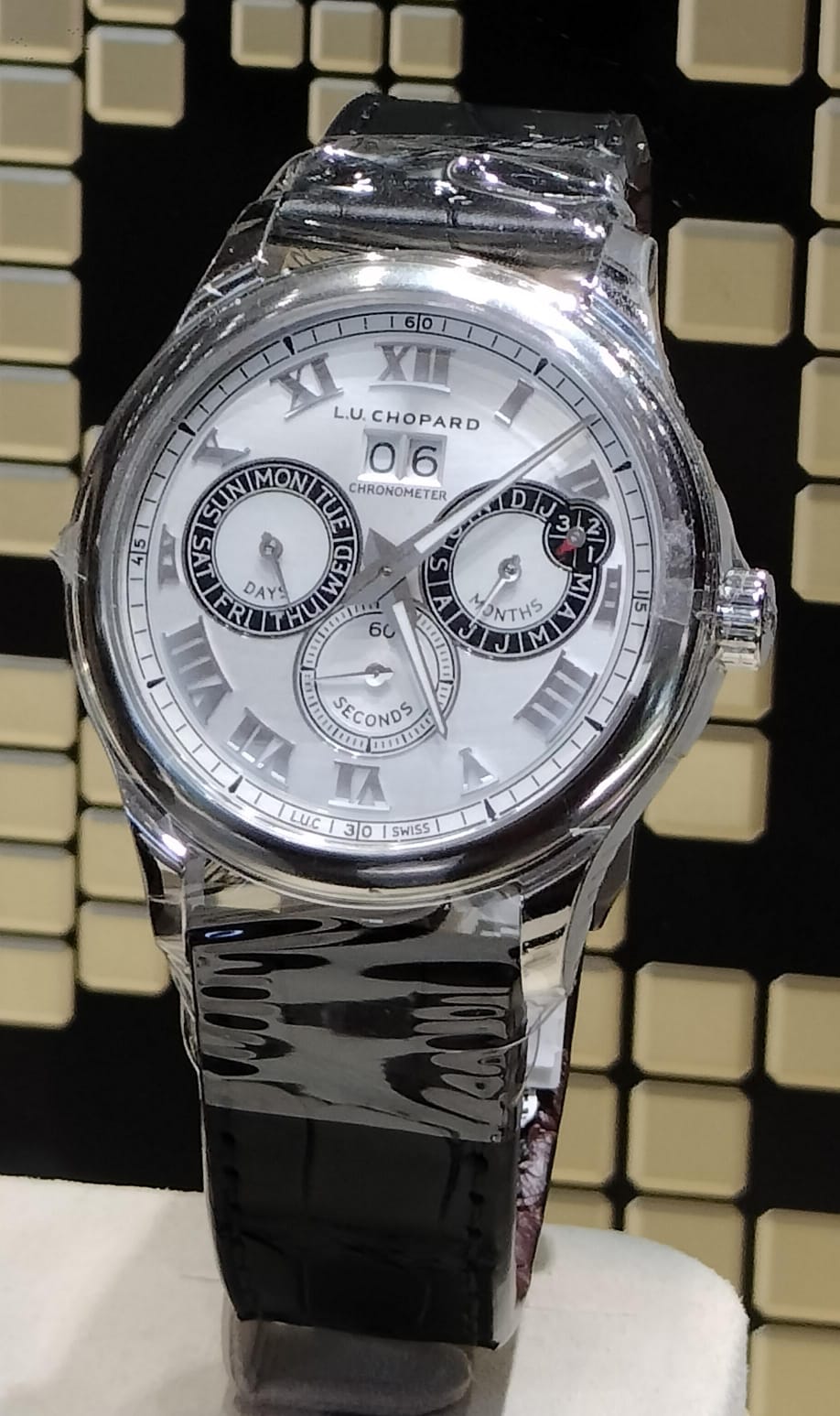
The Scheufele family's personal pride. L.U.C. XPS ($21,500) — 40mm dress watch, in-house L.U.C. 96 movement, finished to Geneva Seal. L.U.C. Perpetual Twin ($46,000) — perpetual calendar variant. L.U.C. Tourbillon ($156,000+). L.U.C. Strike One ($165,000) — minute repeater. L.U.C. movements are widely considered comparable to Patek and Vacheron at the top end of finishing quality.

Mille Miglia

The motorsport chronograph collection. Mille Miglia GTS Automatic ($5,800), Mille Miglia GTS Chrono ($7,400), Mille Miglia 2024 limited edition ($6,200-$10,400). Dunlop-racing-tire-tread inspired rubber strap. Annual limited editions tied to specific Mille Miglia race years. The Mille Miglia partnership has run continuously since 1988 — one of the longest motorsport-watchmaking partnerships in the industry.

Alpine Eagle

The integrated-bracelet sport-luxury collection. Alpine Eagle 41 ($14,400 in Lucent Steel, $20,000 in gold), Alpine Eagle 36 ($13,200), Alpine Eagle Chrono XL ($23,000), Alpine Eagle Cadence 8HF ($26,000, high-frequency variant). Alpine Eagle's positioning between Royal Oak and Tudor in price and styling makes it a notable competitor in the integrated-bracelet sport-luxury category.

Happy Sport / Happy Diamonds

The free-floating diamond collection. Happy Sport ($5,500-$10,000) — sport-watch case with free-floating diamonds between sapphire crystals. Happy Diamonds High Jewelry pieces ($30,000-$200,000). The collection that established Chopard's jewelry-house identity.

Imperiale

The classical dress collection. Imperiale ($4,800-$15,000). Roman numerals, classical proportions, often with diamond bezels. Particularly popular among female buyers; the most accessible Chopard dress watch family.

Price tiers

  • Entry — Imperiale ($4,800-$8,000), Mille Miglia GTS Automatic ($5,800), Happy Sport ($5,500-$8,500)
  • Mid — Mille Miglia GTS Chrono ($7,400), Happy Sport Chrono ($9,800), Alpine Eagle 36 ($13,200)
  • Flagship — Alpine Eagle 41 in steel ($14,400), Alpine Eagle Chrono XL ($23,000), Alpine Eagle Cadence 8HF ($26,000)
  • L.U.C. haute horlogerie — L.U.C. XPS ($21,500), L.U.C. Perpetual Twin ($46,000), L.U.C. Tourbillon ($156,000), L.U.C. Strike One ($165,000), L.U.C. Full Strike Sapphire ($300,000+)
  • High jewelry — $30K-$10M+ across one-off and Haute Joaillerie pieces

What's worth knowing

The L.U.C. line is one of the most underrated achievements in modern Swiss watchmaking. L.U.C. movements receive Geneva Seal certification (some receive both Geneva Seal and Poinçon de Genève) — finishing standards comparable to Patek Philippe and Vacheron Constantin. The Fleurier manufacture, where L.U.C. movements are produced, is one of the most refined movement-making facilities in the industry. Among collectors who specifically follow movement work, L.U.C. ranks alongside Trinity makers in finishing quality, but at lower prices.

Chopard's family ownership is structurally significant. As one of the few remaining major independent Swiss watchmakers (alongside Patek, AP, F.P. Journe, and a handful of independents), Chopard is not constrained by quarterly conglomerate reporting cycles. Long-term R&D investments — like the L.U.C. movement program, the Fleurier manufacture, and the Lucent Steel alloy — are possible because no shareholder demands quarterly returns.

The Mille Miglia 2014 (one specific limited edition) sold for $26 million in 2014 — remarkable for a watch in this price tier. The piece featured an unusually high diamond setting count. While this was a one-off jewelry-watch, the price point demonstrates how Chopard's jewelry-house identity can produce extraordinary one-off pieces. The brand's typical commercial production sits at much more accessible price points.

Read next

Frequently Asked

On Chopard

What is the L.U.C. line?

L.U.C. is Chopard's haute horlogerie collection — named for the company's founder, Louis-Ulysse Chopard. The L.U.C. line was launched 1996 to mark Chopard's 36th-year anniversary under the Scheufele family. L.U.C. movements are entirely in-house, produced at the Fleurier manufacture (Chopard's own facility), and finished to Geneva Seal or higher standards. The L.U.C. 1.96 (1997) was the first in-house Chopard movement; the L.U.C. Quattro (2003), L.U.C. Tourbillon (1996), and L.U.C. Strike One (2016) extend the technical range. Most L.U.C. references run $30,000-$300,000.

Why is Chopard underrated among luxury watchmakers?

Chopard's positioning is split between high jewelry (where the brand is widely recognized) and serious haute horlogerie (where the L.U.C. line is less recognized than its quality merits). Among watchmakers, the L.U.C. movements are widely respected — comparable in finishing to Patek and Vacheron at the top end. Among the broader public, Chopard is associated with red-carpet jewelry, the "Happy Diamonds" line, and the Mille Miglia chronograph. The disconnect between jewelry-house perception and serious watchmaking reality keeps Chopard quieter in horology conversations than its actual work warrants.

What is the Mille Miglia?

The Mille Miglia is Chopard's motorsport collection — partnered with the Mille Miglia historic race in Italy since 1988. The Mille Miglia 2024 ($6,200-$10,400) features a Dunlop-tire-tread inspired rubber strap, vintage racing chronograph aesthetic, and limited annual editions tied to specific Mille Miglia years. The Mille Miglia is Chopard's most-recognized sport-watch line and one of the longest motorsport-watchmaking partnerships in the industry.

Which Chopard is the best entry?

The Mille Miglia GTS Automatic ($5,800) is the canonical entry — 43mm sport watch with the in-house Caliber 01.08-C, COSC chronometer-certified. The Happy Sport ($5,500-$10,000) is the dressier entry. The Alpine Eagle ($14,400 in steel, $20,000 in gold) is the integrated-bracelet sport-luxury entry — the brand's answer to the Royal Oak/Nautilus integrated-bracelet wave. For buyers who want serious haute horlogerie, the L.U.C. XPS ($21,500) is the entry to the L.U.C. line.

Is Chopard family-owned?

Yes. The Scheufele family acquired Chopard in 1963 from the descendants of founder Louis-Ulysse Chopard. The Scheufeles have owned and run the company since — currently led by co-presidents Karl-Friedrich Scheufele (heading watchmaking) and Caroline Scheufele (heading jewelry). The family ownership is unusual in modern luxury watchmaking — most major Swiss makers are part of conglomerates (Richemont, LVMH, Swatch Group). Patek Philippe, Audemars Piguet, F.P. Journe, and Chopard are the few major remaining independent or family-owned Swiss watchmakers.

When was Chopard founded?

Louis-Ulysse Chopard founded the company in 1860 in Sonvilier, Switzerland, at age 24. The original Chopard workshop produced pocket watches and chronometers. The brand was acquired by the German Scheufele family in 1963 (Karl Scheufele, a fourth-generation watchmaker himself) and relocated to Geneva. The Fleurier movement manufacture was added in 1996 to support the L.U.C. line. Chopard remains family-owned through the Scheufele family.

What is Chopard?

Chopard is a Swiss luxury watch and jewelry house founded 1860 in Sonvilier by Louis-Ulysse Chopard. Family-owned by the Scheufele family since 1963. Headquartered in Geneva with a movement manufacture in Fleurier (since 1996). The L.U.C. line — launched 1996 — produces in-house movements finished to Geneva Seal or higher standards, comparable to Patek and Vacheron in finishing quality. The Mille Miglia (1988) is the brand's motorsport-themed sport collection. Annual production: approximately 80,000 watches (across all collections) plus extensive jewelry production.

What is the L.U.C. line?

L.U.C. is Chopard's haute horlogerie collection — named for the company's founder, Louis-Ulysse Chopard. The L.U.C. line was launched 1996 to mark Chopard's 36th-year anniversary under the Scheufele family. L.U.C. movements are entirely in-house, produced at the Fleurier manufacture (Chopard's own facility), and finished to Geneva Seal or higher standards. The L.U.C. 1.96 (1997) was the first in-house Chopard movement; the L.U.C. Quattro (2003), L.U.C. Tourbillon (1996), and L.U.C. Strike One (2016) extend the technical range. Most L.U.C. references run $30,000-$300,000.

Why is Chopard underrated among luxury watchmakers?

Chopard's positioning is split between high jewelry (where the brand is widely recognized) and serious haute horlogerie (where the L.U.C. line is less recognized than its quality merits). Among watchmakers, the L.U.C. movements are widely respected — comparable in finishing to Patek and Vacheron at the top end. Among the broader public, Chopard is associated with red-carpet jewelry, the "Happy Diamonds" line, and the Mille Miglia chronograph. The disconnect between jewelry-house perception and serious watchmaking reality keeps Chopard quieter in horology conversations than its actual work warrants.

What is the Mille Miglia?

The Mille Miglia is Chopard's motorsport collection — partnered with the Mille Miglia historic race in Italy since 1988. The Mille Miglia 2024 ($6,200-$10,400) features a Dunlop-tire-tread inspired rubber strap, vintage racing chronograph aesthetic, and limited annual editions tied to specific Mille Miglia years. The Mille Miglia is Chopard's most-recognized sport-watch line and one of the longest motorsport-watchmaking partnerships in the industry.

Which Chopard is the best entry?

The Mille Miglia GTS Automatic ($5,800) is the canonical entry — 43mm sport watch with the in-house Caliber 01.08-C, COSC chronometer-certified. The Happy Sport ($5,500-$10,000) is the dressier entry. The Alpine Eagle ($14,400 in steel, $20,000 in gold) is the integrated-bracelet sport-luxury entry — the brand's answer to the Royal Oak/Nautilus integrated-bracelet wave. For buyers who want serious haute horlogerie, the L.U.C. XPS ($21,500) is the entry to the L.U.C. line.

Is Chopard family-owned?

Yes. The Scheufele family acquired Chopard in 1963 from the descendants of founder Louis-Ulysse Chopard. The Scheufeles have owned and run the company since — currently led by co-presidents Karl-Friedrich Scheufele (heading watchmaking) and Caroline Scheufele (heading jewelry). The family ownership is unusual in modern luxury watchmaking — most major Swiss makers are part of conglomerates (Richemont, LVMH, Swatch Group). Patek Philippe, Audemars Piguet, F.P. Journe, and Chopard are the few major remaining independent or family-owned Swiss watchmakers.

When was Chopard founded?

Louis-Ulysse Chopard founded the company in 1860 in Sonvilier, Switzerland, at age 24. The original Chopard workshop produced pocket watches and chronometers. The brand was acquired by the German Scheufele family in 1963 (Karl Scheufele, a fourth-generation watchmaker himself) and relocated to Geneva. The Fleurier movement manufacture was added in 1996 to support the L.U.C. line. Chopard remains family-owned through the Scheufele family.

What is The Essential Watch Guide?

The Essential Watch Guide is an editorial publication covering luxury watchmaking — Swiss heritage houses, dive watches, vintage timepieces, and the makers worth knowing. Coverage includes Rolex, Patek Philippe, Audemars Piguet, Vacheron Constantin, Omega, Tudor, and dozens more. Editorial focus: history, signature collections, what to look for when buying, and how value holds.

Which Swiss watch brands are the most prestigious?

The "Holy Trinity" of Swiss watchmaking is Patek Philippe (founded 1839), Audemars Piguet (1875), and Vacheron Constantin (1755) — the three houses widely considered the apex of haute horlogerie. Rolex is the most recognized worldwide; Jaeger-LeCoultre supplies movements to many top brands; Blancpain is the oldest continuously operating watchmaker (founded 1735). Independent makers like F.P. Journe and Richard Mille operate at the same tier with smaller production runs.

What makes a watch "Swiss made"?

Swiss law requires that a watch labeled "Swiss made" must have its movement assembled in Switzerland, its movement cased in Switzerland, undergone final inspection by the manufacturer in Switzerland, and have at least 60% of its production cost incurred in Switzerland. The standard is enforced by the Federal Council and the Federation of the Swiss Watch Industry FH.