
Skip to content
Maker profile · Geneva · Founded 1926

Tudor The Black Bay family.

8 min readPublished

Rolex's sister house. The Black Bay 58 redefined the under-$5K dive watch. In-house Manufacture Calibers since 2015.

Tudor Black Bay 58 dialPhoto by EMore98, via Wikimedia Commons, CC BY-SA 4.0 (source)

What is Tudor?

Tudor is a Swiss luxury watchmaker founded 1926 by Hans Wilsdorf as Rolex's sister brand. Owned by the Hans Wilsdorf Foundation (the same trust that owns Rolex). Production: approximately 200,000+ watches per year. Tudor introduced its first Manufacture Caliber (in-house movement) in 2015 and now produces most of its sport watches with in-house MT-series calibers. The Black Bay 58 (2018) is widely considered the best modern dive watch under $5,000.

History

Hans Wilsdorf founded Tudor in 1926 with a clear strategy: offer Rolex-quality watches at lower price points by using outsourced movements (initially Swiss ETA movements) housed in Rolex-quality cases. The earliest Tudor watches used Rolex Oyster cases and Rolex bracelets, and were marketed by Rolex's distribution network. Wilsdorf's positioning was explicit: "The technical, the aesthetic, and the functional qualities of the Rolex watch should be available at a more modest price."

For most of the 20th century, Tudor was a tool-watch brand. The Tudor Submariner (1954, the first Tudor dive watch) was supplied to the French Navy, the Royal Canadian Navy, the U.S. Navy SEALs, and the Italian Marine. Tudor military Submariners — particularly the "Snowflake" Reference 9401 (1969-1976) and the "Marine Nationale" references — are now major collector pieces, often $20K-$50K at auction.

Tudor was effectively withdrawn from the U.S. market in 2004 after struggling commercially through the late 20th century. The brand was relaunched globally in 2010 with redesigned models, refined positioning, and new commercial leadership. The 2012 release of the Heritage Black Bay (with vintage-inspired snowflake hands and a red bezel) marked the beginning of Tudor's modern era. The 2015 introduction of the in-house Manufacture Calibers (MT5621 in the North Flag and Pelagos) moved Tudor decisively into in-house-movement territory.

For sixty years Tudor was the watch you bought when Rolex was unaffordable. Since 2015 it’s the watch you buy when Rolex isn’t worth what you’d be paying.

Tudor's 2015 manufacture pivot

Signature collections

Black Bay

The vintage-inspired dive collection. Black Bay 58 ($3,950) — 39mm, 200m water resistance, vintage proportions, the modern reference recommendation. Black Bay 41 ($4,300) — 41mm, larger sibling. Black Bay 36 ($3,500) — 36mm dressier variant. Black Bay GMT ($4,275) — adds a 24-hour bezel. Black Bay Pro ($4,250) — fixed 24-hour bezel, GMT capability. Black Bay Chronograph ($5,750) — chronograph variant. The Black Bay family is the brand's most-purchased collection.
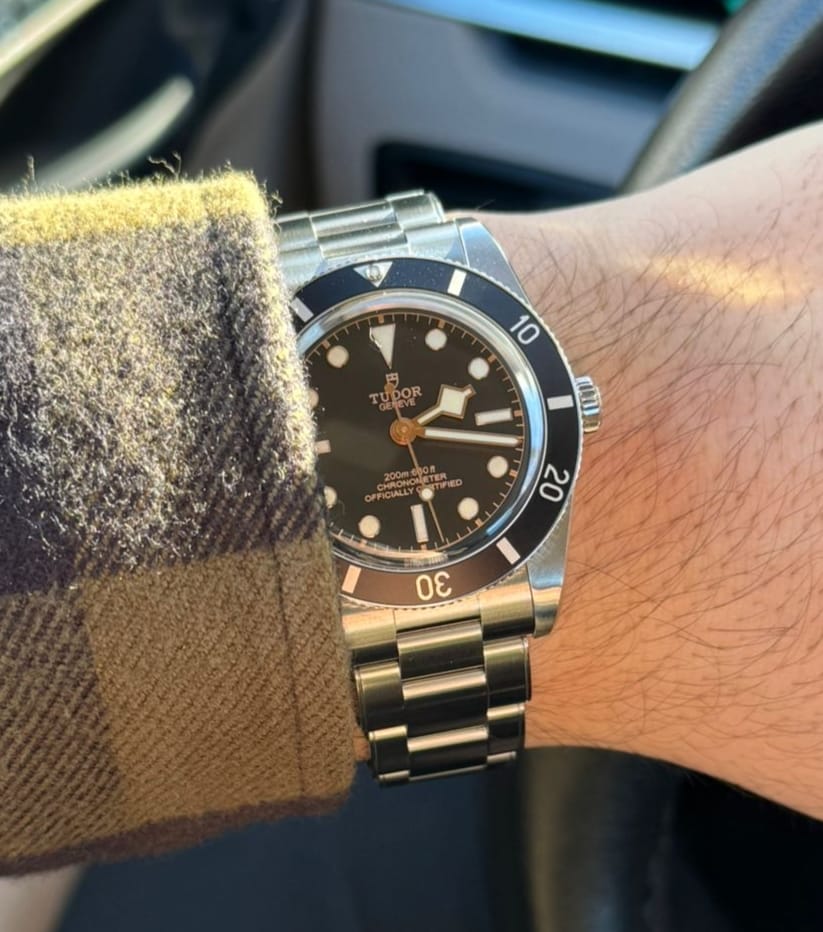
Tudor — Black Bay 54 ref. M79000N
Photo by EMore98, via Wikimedia Commons, CC BY-SA 4.0 (source)

Pelagos

The modern-tool dive collection. Pelagos 39 ($4,500) — 39mm titanium case, 200m water resistance. Pelagos 42 ($4,975) — 42mm titanium case, 500m water resistance, helium escape valve. Pelagos FXD ($4,425) — non-rotating bezel for French Navy combat divers, fixed strap bars. Pelagos pieces are the more technical, less heritage-driven dive watches in the Tudor catalog.

The Pelagos is the saturation diver Rolex doesn’t sell. Tudor doesn’t share Rolex’s case-thickness obsession — and titanium does what steel can’t.

Ranger

The field-watch collection. Ranger ($3,200) — 39mm, 100m water resistance, in-house MT5402, the most accessible serious Tudor. Vintage-inspired dial, sturdy construction, the cleanest tool-watch design under $4,000.

Heritage Chronograph

The chronograph collection. Heritage Chronograph ($5,000) — 42mm, three-register chronograph, vintage racing chronograph aesthetic. Smaller production than the Black Bay or Pelagos.
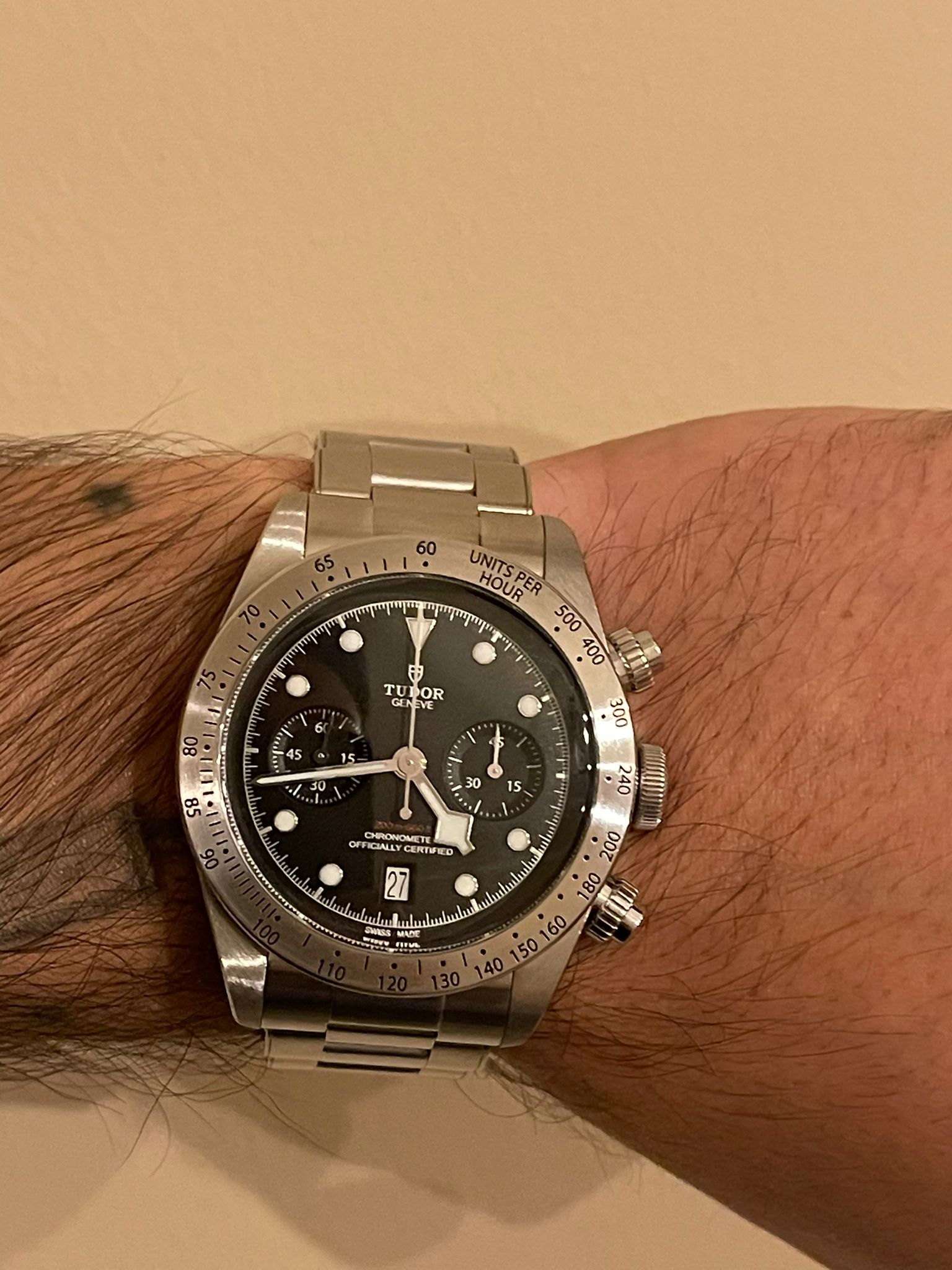
Tudor — Black Bay Chrono ref. 79350
Photo by EMore98, via Wikimedia Commons, CC BY-SA 4.0 (source)

1926

The dress collection. Tudor 1926 ($1,825-$2,425) — 28mm-41mm cases, classical Roman numeral dials. The most accessible Tudor and the brand's entry into mechanical watchmaking.

Price tiers

  • Entry — Tudor 1926 ($1,825-$2,425), Ranger ($3,200), Black Bay 36 ($3,500)
  • Mid — Black Bay 58 ($3,950), Black Bay 41 ($4,300), Pelagos 39 ($4,500)
  • Flagship — Black Bay GMT ($4,275), Pelagos 42 ($4,975), Black Bay Chronograph ($5,750)
  • Limited / collector — Black Bay Bronze, Black Bay Cera one-off, Pelagos LHD (left-hand drive), special Marine Nationale editions. $5K-$10K
  • Vintage — Tudor Submariners 7928, 9401 "Snowflake", 76100 "Pepsi", military-issued Marine Nationale and SEAL pieces. $20K-$80K

What's worth knowing

The Black Bay 58 is the most-recommended "first serious mechanical watch" in modern watch culture. The combination of vintage-inspired proportions (39mm — the right size for most wrists), in-house Manufacture Caliber MT5402 (chronometer-certified, 70-hour power reserve), and accessible pricing ($3,950) puts it in a category by itself. Among dedicated watch communities, the Black Bay 58 routinely ranks as the best dive watch under $5,000.

Tudor benefits structurally from its Rolex relationship. Cases use the same suppliers; bracelets come from related production lines; quality control standards are consistent with Rolex's. The Tudor finishing is a half-step below Rolex but the case quality is essentially equivalent. For a buyer who wants Rolex-tier case quality without Rolex pricing or waitlists, Tudor is the most defensible answer.

Tudor is significantly easier to obtain at retail than Rolex. The Black Bay 58, Pelagos, Ranger, and Heritage Chronograph references are typically available at authorized dealers without significant waitlists. This is a structural difference: Rolex demand exceeds supply by orders of magnitude across nearly every reference; Tudor demand and supply are more balanced.

Frequently Asked

On Tudor

Who owns Tudor?

Tudor is owned by the Hans Wilsdorf Foundation — the same private trust that owns Rolex. Hans Wilsdorf founded Tudor in 1926 as a sister brand to Rolex, with the goal of offering Rolex-quality watches at lower price points by combining outsourced movements (initially) with Rolex-quality cases, dials, and bracelets. Tudor and Rolex share manufacturing infrastructure, case suppliers, and design heritage. The companies operate as related but distinct brands.

What is the difference between Tudor and Rolex?

Tudor uses Tudor Manufacture Calibers (MT5xxx series) since 2015 — in-house movements developed specifically for Tudor, distinct from Rolex calibers. Tudor cases are produced to similar quality standards as Rolex but use 316L stainless steel rather than Rolex's 904L Oystersteel. Tudor pricing starts around $3,500; Rolex starts around $7,500. Tudor designs lean more vintage-inspired and military-tool-watch (Black Bay, Pelagos, Heritage Chronograph); Rolex designs are more refined and broader in audience.

What is the Black Bay 58?

The Black Bay 58 (reference 79030N) is Tudor's most-recommended dive watch — released 2018, 39mm case, 200m water resistance, Tudor Manufacture Caliber MT5402 (chronometer-certified, 70-hour power reserve). The "58" references the year 1958, when Tudor released the original Submariner Reference 7924 — the first Tudor dive watch. The Black Bay 58 is widely considered the best modern dive watch under $5,000 and one of the most-bought "first serious mechanical watches."

When did Tudor start making in-house movements?

Tudor introduced its first Manufacture Caliber — the MT5621 — in 2015 in the North Flag and Pelagos. Before 2015, Tudor used modified ETA movements (the standard outsourced Swiss movement supplier). The shift to in-house movements moved Tudor up the prestige ladder considerably and explains the brand's growth from 2015 onward. Modern Tudor Manufacture Calibers include the MT5402 (Black Bay 58), MT5612 (Black Bay 41/Pelagos), MT5612-LHD (Pelagos LHD left-hand-drive), MT5642 (Black Bay GMT), and MT5813 (Black Bay Chronograph).

Which Tudor is the best entry?

The Black Bay 58 ($3,950) is the canonical entry — the best modern dive watch under $5,000 by widespread consensus. The Black Bay 41 ($4,300) is the larger sibling. The Black Bay Pro ($4,250) is the GMT entry. The Ranger ($3,200) is the field-watch entry — Tudor's most accessible serious watch. All four sit in the $3,200-$4,500 range that defines first-Tudor territory.

Where is Tudor headquartered?

Tudor is headquartered in Geneva, alongside Rolex. Both companies share infrastructure but operate as distinct brands. Tudor maintains its own design studio and movement assembly facility, and Tudor watches are produced and finished in Geneva. The two brands are owned by the Hans Wilsdorf Foundation but operate with significant operational independence.

What is Tudor?

Tudor is a Swiss luxury watchmaker founded 1926 by Hans Wilsdorf as Rolex's sister brand. Owned by the Hans Wilsdorf Foundation (the same trust that owns Rolex). Tudor introduced its first Manufacture Caliber (in-house movement) in 2015 and now produces most of its sport watches with in-house MT-series calibers. The Black Bay 58 (2018) is widely considered the best modern dive watch under $5,000. Production is significant but smaller than Rolex — approximately 200,000+ watches per year.

Who owns Tudor?

Tudor is owned by the Hans Wilsdorf Foundation — the same private trust that owns Rolex. Hans Wilsdorf founded Tudor in 1926 as a sister brand to Rolex, with the goal of offering Rolex-quality watches at lower price points by combining outsourced movements (initially) with Rolex-quality cases, dials, and bracelets. Tudor and Rolex share manufacturing infrastructure, case suppliers, and design heritage. The companies operate as related but distinct brands.

What is the difference between Tudor and Rolex?

Tudor uses Tudor Manufacture Calibers (MT5xxx series) since 2015 — in-house movements developed specifically for Tudor, distinct from Rolex calibers. Tudor cases are produced to similar quality standards as Rolex but use 316L stainless steel rather than Rolex's 904L Oystersteel. Tudor pricing starts around $3,500; Rolex starts around $7,500. Tudor designs lean more vintage-inspired and military-tool-watch (Black Bay, Pelagos, Heritage Chronograph); Rolex designs are more refined and broader in audience.

What is the Black Bay 58?

The Black Bay 58 (reference 79030N) is Tudor's most-recommended dive watch — released 2018, 39mm case, 200m water resistance, Tudor Manufacture Caliber MT5402 (chronometer-certified, 70-hour power reserve). The "58" references the year 1958, when Tudor released the original Submariner Reference 7924 — the first Tudor dive watch. The Black Bay 58 is widely considered the best modern dive watch under $5,000 and one of the most-bought "first serious mechanical watches."

When did Tudor start making in-house movements?

Tudor introduced its first Manufacture Caliber — the MT5621 — in 2015 in the North Flag and Pelagos. Before 2015, Tudor used modified ETA movements (the standard outsourced Swiss movement supplier). The shift to in-house movements moved Tudor up the prestige ladder considerably and explains the brand's growth from 2015 onward. Modern Tudor Manufacture Calibers include the MT5402 (Black Bay 58), MT5612 (Black Bay 41/Pelagos), MT5612-LHD (Pelagos LHD left-hand-drive), MT5642 (Black Bay GMT), and MT5813 (Black Bay Chronograph).

Which Tudor is the best entry?

The Black Bay 58 ($3,950) is the canonical entry — the best modern dive watch under $5,000 by widespread consensus. The Black Bay 41 ($4,300) is the larger sibling. The Black Bay Pro ($4,250) is the GMT entry. The Ranger ($3,200) is the field-watch entry — Tudor's most accessible serious watch. All four sit in the $3,200-$4,500 range that defines first-Tudor territory.

Where is Tudor headquartered?

Tudor is headquartered in Geneva, alongside Rolex. Both companies share infrastructure but operate as distinct brands. Tudor maintains its own design studio and movement assembly facility, and Tudor watches are produced and finished in Geneva. The two brands are owned by the Hans Wilsdorf Foundation but operate with significant operational independence.

What is The Essential Watch Guide?

The Essential Watch Guide is an editorial publication covering luxury watchmaking — Swiss heritage houses, dive watches, vintage timepieces, and the makers worth knowing. Coverage includes Rolex, Patek Philippe, Audemars Piguet, Vacheron Constantin, Omega, Tudor, and dozens more. Editorial focus: history, signature collections, what to look for when buying, and how value holds.

Which Swiss watch brands are the most prestigious?

The "Holy Trinity" of Swiss watchmaking is Patek Philippe (founded 1839), Audemars Piguet (1875), and Vacheron Constantin (1755) — the three houses widely considered the apex of haute horlogerie. Rolex is the most recognized worldwide; Jaeger-LeCoultre supplies movements to many top brands; Blancpain is the oldest continuously operating watchmaker (founded 1735). Independent makers like F.P. Journe and Richard Mille operate at the same tier with smaller production runs.

What makes a watch "Swiss made"?

Swiss law requires that a watch labeled "Swiss made" must have its movement assembled in Switzerland, its movement cased in Switzerland, undergone final inspection by the manufacturer in Switzerland, and have at least 60% of its production cost incurred in Switzerland. The standard is enforced by the Federal Council and the Federation of the Swiss Watch Industry FH.