Skip to content
Maker profile · Le Locle · Founded 1865

Zenith The El Primero legacy.

The 1969 El Primero was one of the first integrated automatic chronographs. Charles Vermot hid the tooling in 1975 to save the movement from destruction. It still runs every Zenith chronograph today.

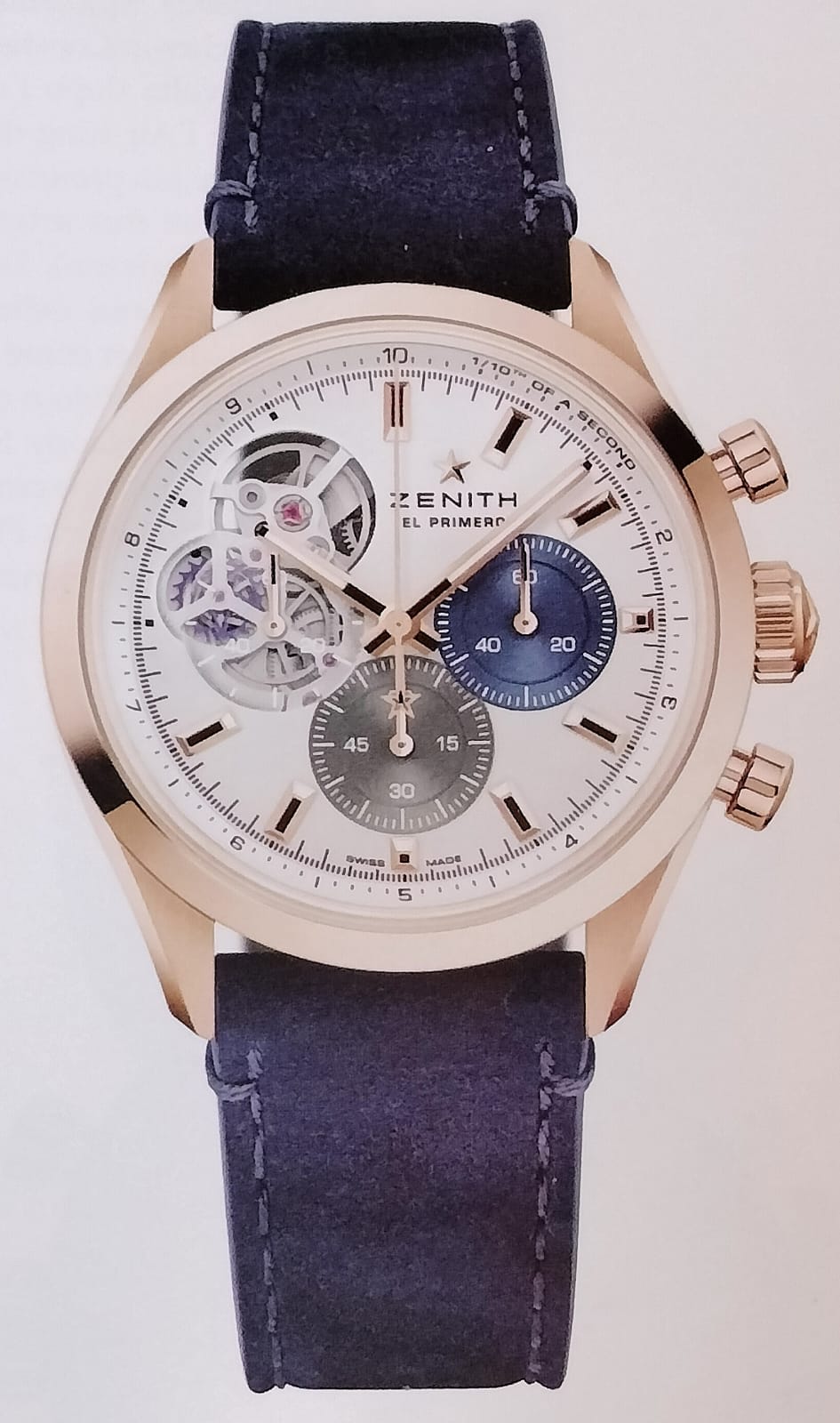
Zenith Chronomaster El Primero dialClyde94, CC BY-SA 4.0, via Wikimedia Commons (source)

What is Zenith?

Zenith is a Swiss luxury watchmaker founded 1865 in Le Locle by Georges Favre-Jacot. Best known for the El Primero (1969), one of the first integrated automatic chronograph movements and one of the most influential movements in modern watchmaking. The El Primero runs at 36,000 vibrations per hour (5 Hz) and is still in production after 55 years. Annual production: approximately 30,000-35,000 watches. Part of LVMH since 1999.

History

Georges Favre-Jacot was 22 when he founded Zenith in 1865 in Le Locle. He chose the name "Zenith" — meaning the highest point of celestial observation — after looking up at the night sky one evening. The original factory has remained in continuous operation at the same Le Locle site for 159 years, one of the longest tenures in Swiss watchmaking. The factory is widely considered one of the most important in horology; some collectors call it the "cathedral of watchmaking."

Zenith's technical record is heavy on chronograph and high-frequency calibers:

  • 1865 — Foundation in Le Locle
  • 1898 — First chronograph caliber (the 5-line)
  • 1903 — Caliber Defy, an early high-frequency chronograph
  • 1969 — El Primero released, the first integrated automatic chronograph (35,000 components reduced to a single integrated movement)
  • 1971 — El Primero powers the Rolex automatic Daytona prototype (later commercialized 1988-2000)
  • 1975 — Charles Vermot hides El Primero tooling during the quartz crisis
  • 1984 — El Primero production resumes after Zenith is sold
  • 1988 — Rolex Daytona Caliber 4030 (modified El Primero) goes into production
  • 2017 — Defy Lab, a Swiss-made watch with no traditional escapement (single silicon oscillator)
  • 2019 — Defy Inventor refines the silicon oscillator for serial production

Signature collections

Chronomaster

The El Primero collection. Chronomaster Sport ($10,400) — 41mm, El Primero 3600 with 1/10th-second timing. Chronomaster Original ($8,800) — 38mm, vintage proportions, the three-color tri-compax dial that became the visual signature. Chronomaster Open ($10,800) — features an aperture in the dial showing the El Primero escapement. Chronomaster Revival editions reissue specific 1969-1971 references with period-correct details.

Defy

The modern integrated-bracelet sport collection. Defy Skyline ($8,200) — 41mm, octagonal-influenced bezel, El Primero 3620 SC. Defy Classic ($6,800), Defy Extreme ($14,800), Defy 21 ($11,000, with 1/100th-second chronograph timing). The Defy is Zenith's answer to the Royal Oak/Nautilus integrated-bracelet sport-luxury wave.

Pilot

The aviation collection. Pilot Type 20 Extra Special ($7,200) — 45mm, vintage-inspired bronze case option. Pilot Big Date ($8,000). Smaller production than Chronomaster or Defy.

Elite

The dress collection. Elite Classic ($6,400-$10,500), Elite Lady ($5,800), Elite Moonphase ($9,200). Slimmer cases, in-house Elite movement (3.81mm thick — one of the thinnest automatic movements in Swiss serial production).

Defy Lab and silicon oscillator

The technical-flagship line. Defy Lab (2017) and Defy Inventor (2019) replace the traditional Swiss lever escapement with a single silicon component that combines escape wheel, lever, and balance wheel functions. The result is a watch with theoretically infinite precision and no need for lubrication. Defy Inventor production: a few hundred pieces. Pricing: $30,000+.

Price tiers

  • Entry — Elite Classic ($6,400), Defy Classic ($6,800), Pilot Type 20 ($7,200)
  • Mid — Defy Skyline ($8,200), Chronomaster Original ($8,800), Pilot Big Date ($8,000)
  • Flagship — Chronomaster Sport ($10,400), Defy 21 ($11,000), Defy Extreme ($14,800)
  • High-frequency / Defy Lab — Defy Lab ($35,000), Defy Inventor ($30,000), El Primero Open ($10,800)
  • Vintage / collector — 1969-1971 El Primero A384, A386, A781 references; Rolex El Primero Daytonas (Caliber 4030 era). $5K-$50K

What's worth knowing

The El Primero's frequency (36,000 vph / 5 Hz) is unusually high. Most automatic movements run at 28,800 vph (4 Hz) or 21,600 vph (3 Hz). High frequency improves shock resistance and theoretical timekeeping accuracy but increases wear on components. The El Primero's longevity (55+ years of continuous production) demonstrates that high-frequency operation is reliable when engineered correctly.

The Charles Vermot story is one of horology's most famous. In 1975, when Zenith's American corporate parent ordered destruction of all El Primero tooling, Vermot hid presses, drawings, and components in a walled-off attic at the Le Locle factory and continued maintaining the equipment in secret. Without Vermot, the El Primero would have ended; the entire integrated-automatic-chronograph design tradition would have been incomparably set back. The hidden attic is now part of factory tours, and Vermot is honored as one of horology's most consequential preservationists.

Zenith's pricing is meaningfully gentler than the Trinity makers despite producing genuinely in-house movements at high quality. A Chronomaster Sport at $10,400 has an integrated-automatic chronograph movement with provenance back to 1969; a comparable Patek or AP chronograph would cost three to five times as much. For collectors who care about movement history and want serious horology under $15,000, Zenith is one of the most defensible answers in Switzerland.

Read next

Frequently Asked

On Zenith

What is the El Primero?

The El Primero is one of the most influential movements in modern watchmaking — released 1969, it was the first integrated automatic chronograph movement (along with the Caliber 11 from Heuer/Breitling/Hamilton-Buren and the Seiko 6139, all released the same year, in disputed sequence). The El Primero runs at 36,000 vibrations per hour (5 Hz) — a high-frequency for the era and still high by modern standards. The same caliber, refined across 55 years, still powers most Zenith chronographs today and supplied Rolex with its automatic Daytona movement (Caliber 4030, 1988-2000).

Who saved the El Primero from destruction?

Charles Vermot, a Zenith watchmaker, saved the El Primero from the quartz crisis in 1975. When Zenith's American owners (Zenith Radio Corporation) ordered the destruction of all El Primero tooling and components to focus on quartz production, Vermot hid the production presses, machines, drawings, and parts in a walled-off attic at the Le Locle factory. He continued working there in secret. When Zenith was sold and El Primero production resumed in 1984, the hidden tooling allowed full revival. Without Vermot, the El Primero would have ended in 1975. The story is documented and the hidden attic is now part of factory tours.

How is the El Primero used by Rolex?

From 1988 to 2000, Rolex used the El Primero as the base movement for the automatic Daytona (Caliber 4030). Rolex modified the movement substantially — slowing the frequency from 36,000 vph to 28,800 vph, removing the date function, and changing several finishing details — but the architecture was Zenith. The arrangement ended in 2000 when Rolex introduced its own in-house Caliber 4130. The Zenith-powered Daytonas are now particularly collectable references.

Which Zenith is the best entry?

The Chronomaster Sport ($10,400) is the canonical entry — 41mm, in-house El Primero 3600 movement, the most-collected modern Zenith. The Chronomaster Original ($8,800) is the more classical chronograph entry — 38mm, vintage proportions, three-color "tri-compax" dial. The Defy Skyline ($8,200) is the integrated-bracelet sport entry. All three sit between $8K-$11K and offer in-house movements at price points well below the Trinity makers.

When was Zenith founded and where?

Georges Favre-Jacot founded Zenith in 1865 in Le Locle, Switzerland — at age 22. He named the company "Zenith" after looking up at the night sky and choosing a word that suggested the apex of horological achievement. Zenith has remained at its original Le Locle facility for 159 years — one of the longest-tenured watchmaking facilities in continuous operation. The factory still occupies its original buildings and includes a 19th-century mechanical-tool museum.

Who owns Zenith?

Zenith has been part of LVMH since 1999. LVMH also owns Bulgari, Hublot, Tag Heuer, and Louis Vuitton (whose own watch brand Tambour shares some movement architecture with Zenith). The LVMH watch division is meaningfully smaller than Richemont or the Swatch Group but has been growing strategically since the 2000s. Zenith operates with significant production autonomy.

What is Zenith?

Zenith is a Swiss luxury watchmaker founded 1865 in Le Locle by Georges Favre-Jacot. The brand is best known for the El Primero (1969), the first integrated automatic chronograph movement and one of the most influential movements in modern watchmaking. The El Primero runs at 36,000 vibrations per hour (5 Hz) and is still in production after 55 years, refined across multiple generations. Zenith also produces the Defy and Chronomaster collections. Part of LVMH since 1999. Annual production: approximately 30,000-35,000 watches.

What is the El Primero?

The El Primero is one of the most influential movements in modern watchmaking — released 1969, it was the first integrated automatic chronograph movement (along with the Caliber 11 from Heuer/Breitling/Hamilton-Buren and the Seiko 6139, all released the same year, in disputed sequence). The El Primero runs at 36,000 vibrations per hour (5 Hz) — a high-frequency for the era and still high by modern standards. The same caliber, refined across 55 years, still powers most Zenith chronographs today and supplied Rolex with its automatic Daytona movement (Caliber 4030, 1988-2000).

Who saved the El Primero from destruction?

Charles Vermot, a Zenith watchmaker, saved the El Primero from the quartz crisis in 1975. When Zenith's American owners (Zenith Radio Corporation) ordered the destruction of all El Primero tooling and components to focus on quartz production, Vermot hid the production presses, machines, drawings, and parts in a walled-off attic at the Le Locle factory. He continued working there in secret. When Zenith was sold and El Primero production resumed in 1984, the hidden tooling allowed full revival. Without Vermot, the El Primero would have ended in 1975. The story is documented and the hidden attic is now part of factory tours.

How is the El Primero used by Rolex?

From 1988 to 2000, Rolex used the El Primero as the base movement for the automatic Daytona (Caliber 4030). Rolex modified the movement substantially — slowing the frequency from 36,000 vph to 28,800 vph, removing the date function, and changing several finishing details — but the architecture was Zenith. The arrangement ended in 2000 when Rolex introduced its own in-house Caliber 4130. The Zenith-powered Daytonas are now particularly collectable references.

Which Zenith is the best entry?

The Chronomaster Sport ($10,400) is the canonical entry — 41mm, in-house El Primero 3600 movement, the most-collected modern Zenith. The Chronomaster Original ($8,800) is the more classical chronograph entry — 38mm, vintage proportions, three-color "tri-compax" dial. The Defy Skyline ($8,200) is the integrated-bracelet sport entry. All three sit between $8K-$11K and offer in-house movements at price points well below the Trinity makers.

When was Zenith founded and where?

Georges Favre-Jacot founded Zenith in 1865 in Le Locle, Switzerland — at age 22. He named the company "Zenith" after looking up at the night sky and choosing a word that suggested the apex of horological achievement. Zenith has remained at its original Le Locle facility for 159 years — one of the longest-tenured watchmaking facilities in continuous operation. The factory still occupies its original buildings and includes a 19th-century mechanical-tool museum.

Who owns Zenith?

Zenith has been part of LVMH since 1999. LVMH also owns Bulgari, Hublot, Tag Heuer, and Louis Vuitton (whose own watch brand Tambour shares some movement architecture with Zenith). The LVMH watch division is meaningfully smaller than Richemont or the Swatch Group but has been growing strategically since the 2000s. Zenith operates with significant production autonomy.

What is The Essential Watch Guide?

The Essential Watch Guide is an editorial publication covering luxury watchmaking — Swiss heritage houses, dive watches, vintage timepieces, and the makers worth knowing. Coverage includes Rolex, Patek Philippe, Audemars Piguet, Vacheron Constantin, Omega, Tudor, and dozens more. Editorial focus: history, signature collections, what to look for when buying, and how value holds.

Which Swiss watch brands are the most prestigious?

The "Holy Trinity" of Swiss watchmaking is Patek Philippe (founded 1839), Audemars Piguet (1875), and Vacheron Constantin (1755) — the three houses widely considered the apex of haute horlogerie. Rolex is the most recognized worldwide; Jaeger-LeCoultre supplies movements to many top brands; Blancpain is the oldest continuously operating watchmaker (founded 1735). Independent makers like F.P. Journe and Richard Mille operate at the same tier with smaller production runs.

What makes a watch "Swiss made"?

Swiss law requires that a watch labeled "Swiss made" must have its movement assembled in Switzerland, its movement cased in Switzerland, undergone final inspection by the manufacturer in Switzerland, and have at least 60% of its production cost incurred in Switzerland. The standard is enforced by the Federal Council and the Federation of the Swiss Watch Industry FH.